Building a real-time patient-flow dashboard on Medplum


In fast-paced hospital environments, coordination depends on knowing exactly where patients are and which beds are available. For transfer teams working across multiple facilities, even a few minutes of uncertainty can delay care, create confusion, and add unnecessary cognitive load to already stretched clinical staff.
To support a regional hospital network seeking greater operational visibility, Medplum partnered with Vinta to bring a Transfer Center application to life. The goal: create a real-time, FHIR-native dashboard that displays bed availability, incoming transfers, and patient status updates in a single place.
Medplum’s internal engineering team had initiated the foundation of the project. Vinta joined to accelerate development, refine workflows, and complete the MVP, ensuring the application could demonstrate the power of Medplum as a building block for hospital operations.

Streamlining urgent care coordination: time-pressured clinical staff
Coordinating inter-facility transfers involves multiple teams, dynamic patient conditions, and rapid decision-making. In a typical Urgent Care environment, coordination often relies on manual communication: phone calls, shared documents, and manual updates that required constant reconfirmation.
As development moved forward, the project required balancing three realities common in clinical settings:
- Complex stakeholder alignment:
Physicians, nurses, and coordinators each had distinct expectations about the intake data that should be collected, especially when dealing with specialty-specific flowcharts.
Debates centered on what was mandatory vs. optional, which information should come before or after physician approval, and how much detail each specialty needed to feel confident in the transfer decision.
- Time-pressured clinical staff
Clinical stakeholders participated in defining the product between shifts and clinical duties, often reviewing demos or intake logic asynchronously. To support that reality, most reviews happened through demo videos and structured async feedback. This allowed input from multiple roles without disrupting patient care, and ensured the workflow reflected day-to-day operational patterns.
- Evolving clarity on workflows
The richest insights surfaced once clinicians interacted with early versions of the intake forms. Interacting with real-time status updates helped them identify nuance: what needed to be grouped, which fields slowed them down, and how the adaptive logic should behave when different specialties were involved.

These dynamics weren’t obstacles: they’re inherent to custom software designed around clinical judgment. Tailored care flows require iteration, collaboration, and the flexibility to shape digital tools around the realities of frontline work. This project reinforced why healthcare software must adapt to clinicians—not the other way around.
Turning Medplum into a real-time transfer hub
A live picture of bed availability
To demonstrate real-time operational visibility, Vinta built a Medplum-based dashboard that represented bed status information using HL7 ADT messages.
Although the project used SimHospital test feeds rather than live hospital data, this approach reflected industry best practices for protecting patient privacy while still validating the architecture.
The system processed HL7 ADT messages exactly as a production deployment would (which, in a full implementation, would also create or update the patient’s FHIR Encounter):
- the Medplum Agent securely received and forwarded inbound HL7 ADT events from external systems
- each message updated a FHIR Location.operationalStatus, and
- WebSockets pushed changes instantly to the user interface.
This allowed the MVP to accurately demonstrate how real-time bed status would function in a secure, privacy-preserving setup.

.webp)
Streamlined intake for incoming transfers
To support regional hospitals transferring patients into the network, the team implemented a customizable Patient Intake form that handled:
- demographics,
- vitals,
- complaint-specific fields (e.g., stroke, STEMI, sepsis),
- essential labs and imaging, and
- structured data mapped to Medplum resources.
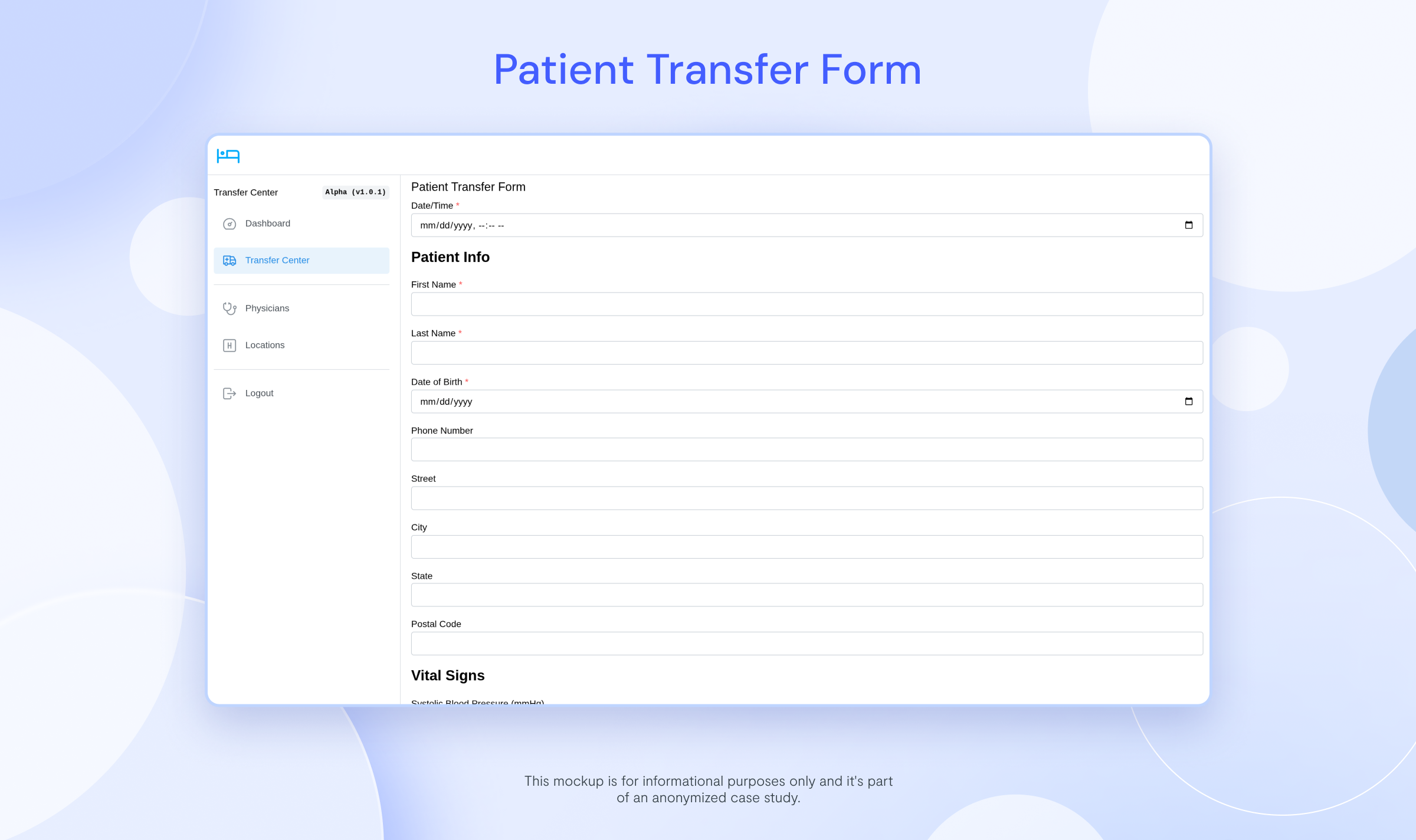
This enabled coordinated, consistent intake without lengthy back-and-forth communication.
Flexible logic that mirrors hospital hierarchy
The app was built with flexibility in mind (from specialty-specific questionnaires to configurable facility hierarchies), reflecting the varied ways hospitals organize transfer workflows.
Instead of enforcing a rigid process, the MVP showed how Medplum’s platform can support clinical teams with different operational realities.
What we learned building for care teams
Building the Transfer Center reinforced several lessons that continue to shape our work in healthcare:
1. Stakeholder diversity requires the right shape of collaboration
Clinicians, coordinators, and administrative staff each surface different aspects of the workflow. By collecting feedback through structured intermediary channels and async review, the team ensured these perspectives contributed to a more realistic, usable product.
2. Clarity grows through iteration
Seeing early versions of the dashboard helped hospital staff articulate nuances that aren’t obvious in written requirements. Each demo refined the mental model of how patient flow should be represented.
3. Industry-specific patterns matter
The project deepened our familiarity with interaction patterns unique to clinical environments, such as heavy reliance on tab-based form navigation and the value of concise, low-friction data entry.
Even small details like these have a large impact on adoption and usability for care teams.
4. HL7 experience adds long-term value
Although the project didn’t run on live production data, working directly with HL7 ADT messages enriched our interoperability toolkit. This practical exposure strengthens our ability to support future EHR modernization and integration projects.
Shaping the foundation for operational visibility
The Transfer Center MVP successfully demonstrated how Medplum can power:
- real-time operational dashboards,
- bed-status synchronization across multiple facilities through HL7 ADT,
- structured, adaptive patient intake workflows, and
- clear visualizations of patient movement at the hospital-network level.
The project also provided both teams with a deeper understanding of how clinical staff interact with patient-flow tools, insights that continue to inform Vinta’s work in healthcare interoperability and hospital operations.

.webp)


.webp)


.jpg)

.webp)