
Everself: extending Medplum’s Provider App to power obesity care workflows


If you’re building a specialty care program that depends on consistent follow-up, tight coordination across a care team, and patient engagement between visits, your tooling eventually becomes part of the product.
Many teams start with Healthie because it’s a pragmatic way to launch quickly. Over time, some care models outgrow what a standardized platform can offer, especially when you need highly tailored provider workflows, embedded communication, and a unified view of the patient journey.
That’s the situation Everself faced: their model required more flexibility in how teams coordinate care, communicate with patients, and operationalize follow-ups at scale, so they reached out for help.
Building a Medplum-based provider portal and communications hub in phases
Everself (formerly Bariendo) is an obesity management platform combining medication programs with next-generation endoscopic interventions. Their model is physician-supervised and telehealth-first, supported by remote monitoring to help patients stay on track between visits.
Everself’s clinical platform blueprint
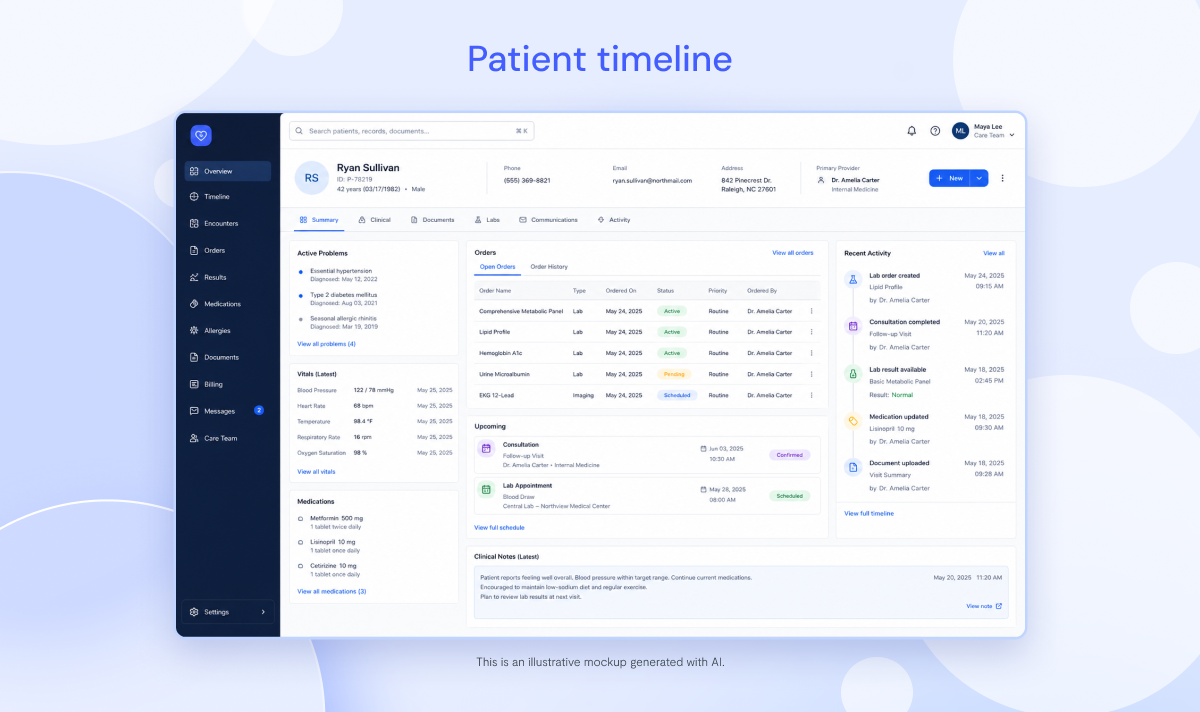
- A Medplum-based provider portal designed to consolidate clinical workflows and patient context
- A real-time communication experience embedded in provider workflows, including calling, SMS, and chat
- Orbit messaging that lets clinical staff send and receive messages with the patient app, with full visibility in the provider timeline.
- A long-term architecture that supports clinical parity and includes future remote monitoring expansion
Getting to know the client and their care model
Everself is making high-quality weight loss care easier to access by working side by side with leading physicians. They combine state-of-the-art procedures and medications with a care model built on rigorous research and structured, long-term follow-up, so patients get consistent support long after the initial intervention.
The company started with a problem that their clinical leaders kept seeing up close. In 2023, they noticed that ESG care varied widely from one patient experience to the next, and essential follow-ups were too often treated as optional. Everself was created to raise the bar by standardizing best practices and pairing the procedure with reliable virtual support that helps patients stay on track over time.
Operationally, this creates a hybrid need: procedures happen at physical partner locations, while most pre- and post-procedure interactions with dietitians, NPs/PAs, and behavioral coaches happen virtually.
The migration challenge: evolving beyond Healthie for a more customized care model
Obesity care is not a single appointment: it is a long journey that requires consistent follow-up, clear accountability across the care team, and timely intervention when patients drift.
As a result, Everself’s stack expanded over time. They used Healthie as their EHR and built an additional provider portal in Retool to better support internal workflows. For calling and texting, they used CallTrackingMetrics. The opportunity was to simplify this setup into a single provider experience that matched their clinical operations.
A very significant pain point Everself shared was communication reliability. Call failures and missed connections happened often enough to be a real concern, because patients might call with urgent needs. The team needed a system where calls and messages reach the right place, and where patient communication history is easy to review.
At that point, Everself faced the classic build vs. buy decision.
Off-the-shelf tools are a strong starting point when you want to launch quickly. But when your care model depends on tighter coordination, embedded communication, and workflow-specific provider UX, the question becomes whether you keep patching around the edges or invest in a platform that you can shape.
Everself chose Medplum as the foundation for that next stage. Medplum is a developer-first, FHIR-native platform that teams use to build and extend clinical applications, so they can tailor workflows without giving up interoperability or long-term flexibility.
Even with the right foundation, getting from “platform” to “provider experience clinicians rely on” takes specialists who can design workflows and implement safely. Everself was introduced to Vinta through the Medplum team, and we partnered to deliver the migration iteratively, starting with the operational layer that unlocks day-to-day follow-through.
.webp)
What we built: a Medplum-based provider portal for specialty care workflows
We optimized for speed, clinical usability, and a foundation that could evolve beyond MVP. To reduce risk while keeping time-to-launch fast, we delivered the smallest set of provider workflows and communication capabilities that made the care model run, then hardened the parts clinicians rely on daily.

Phase 1: a communications hub that replaces CallTrackingMetrics
In the first phase, we delivered a communications hub (a dedicated communications app) focused on replacing CallTrackingMetrics. This phase was intentionally not a full clinical EHR.
What shipped in Phase 1
- A communications experience integrated with Twilio
- Support for calling, chat, and SMS
- Notes support on the patient timeline, including linking a note to a communication and tagging teammates (ex: “@____ please call the patient”)
- A patient timeline containing basic patient context and a complete communication history, so the team can review what happened with that patient in one place
Phase 2: expanding from communications into core clinical workflows
After Phase 1, the next focus is the “clinical baseline”: reaching parity with the workflows Everself relied on in Healthie, while shaping them around their care model and the way their team actually operates day to day.
Phase 2 scope (in progress)
- Lab tests with Health Gorilla integration
- Prescriptions and e-prescribing (eRx), including DoseSpot
- eFax
- Charting
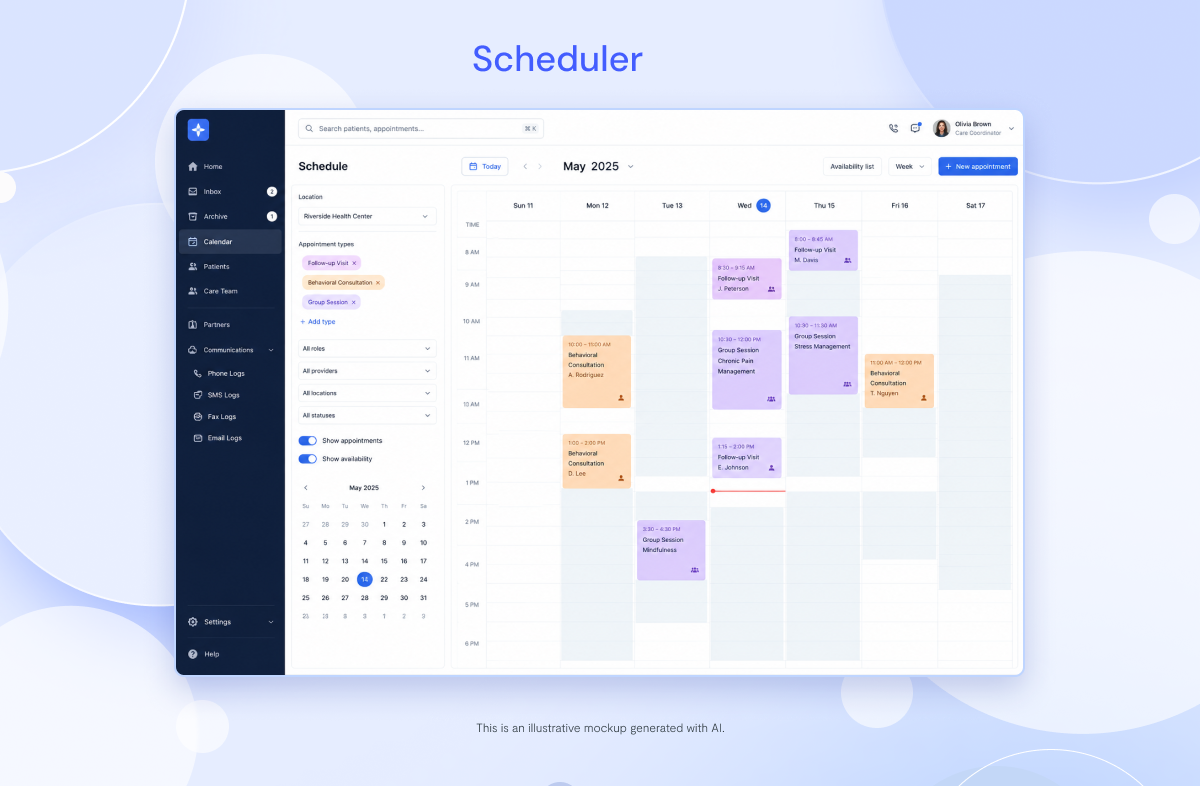
- Scheduling
What Medplum provides as the foundation
Medplum gives Everself a FHIR-native clinical data layer and extensible APIs. That’s the backbone for clinical modules like charting, scheduling, labs, and medication data. It also provides baseline admin tooling and infrastructure primitives (identity, auditing patterns, extensibility hooks) that make it practical to evolve a platform in phases.
What Vinta is building and tailoring in Orbit
Orbit is where Phase 2 becomes a usable clinical workspace. This is the layer that turns raw platform capability into workflows that clinicians and ops teams can rely on.
- Labs (Health Gorilla): integrating third-party lab ordering/results into the clinical workflow, so lab data lands in the patient record in a structured way and can be reviewed in context. The hard part is not “connecting an API”. It’s mapping lab events into the right patient timeline context, handling different result formats, and making the review flow predictable for the care team.
- eRx (DoseSpot): bringing prescribing into the same provider workflow instead of treating it as a separate tool. In practice, this means aligning clinical context (patient, meds, contraindications, follow-up) with prescribing actions, and keeping prescription status visible in Orbit so teams can act without switching systems.
- Charting: designing documentation flows that match how Everself’s clinicians deliver care, not generic note-taking. This is where specialty care needs workflow specificity: templates/structure that reflect the visit type, fast “in-the-moment” documentation, and the ability to connect documentation to operational follow-through (for example, leaving internal notes tied to a patient event so the next action is explicit).
- Scheduling: building scheduling flows that reflect real operational constraints. In specialty care, scheduling is rarely just “pick a time”. It involves provider availability, appointment types, guardrails, and workflow-specific views that help teams coordinate without overbooking or losing track of what the patient needs next. Phase 2 is where Orbit starts supporting those scheduling realities inside the provider experience.
- eFax: enabling clinical document exchange as part of the clinical baseline, so teams can receive, route, and attach faxed artifacts to the right patient context without manual chasing.
This phase shifts Orbit from “communications-first” into a platform that supports day-to-day clinical operations end to end, while keeping the foundation interoperable and evolvable.
Next steps: operational depth, routing, and back office improvements
For later phases, Everself and Vinta discussed expanding complementary capabilities. Some examples already on the roadmap include:
- Improving the back office experience (beyond using the Medplum admin as the only interface)
- Building an IVR (call routing tree, “press 1 for…”) so calls can be redirected based on whether the caller is a new lead or an existing patient, routing to sales or the appropriate care team
These items reflect what happens as a care program scales. The core workflows must exist, but the operational layer becomes a major lever for responsiveness and patient experience.







.webp)