From intake to check-Ins, building CMS-aligned chronic care apps

.webp)
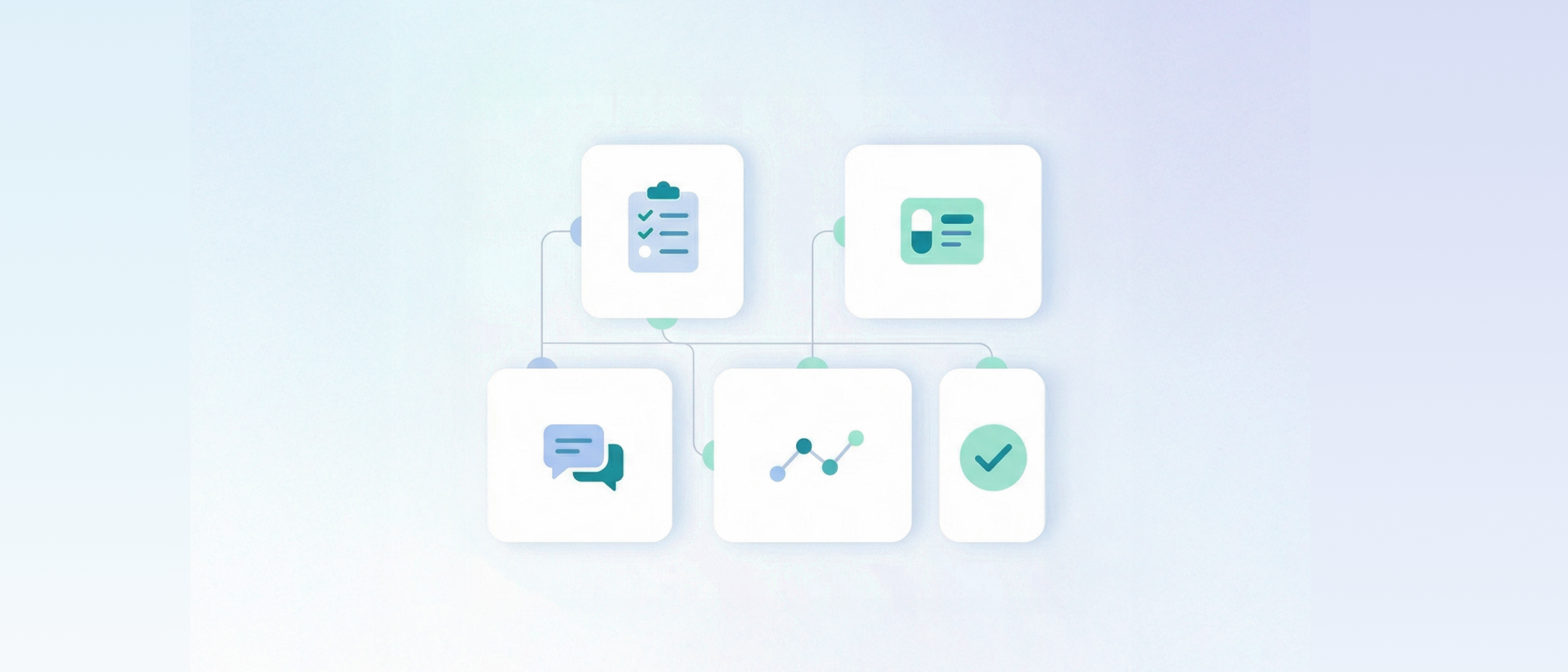
If you’re building digital health products, you’ve probably felt the shift: patient records access, interoperability, and better digital experiences are moving from “nice-to-have” to “this is how the system works now.”
The CMS Health Technology Framework is one more signal in that direction. The message is clear: modern care depends on patients being able to access their health information, use it in real workflows, and move through care without getting stuck in admin friction.
That has a very practical implication for product teams: patient-facing apps have evolved into core infrastructure for care navigation and operational efficiency.
And nowhere is that more obvious than in chronic conditions like diabetes and obesity, where outcomes depend on what happens between visits.
Diabetes and obesity programs: designing for the between-visit reality
Diabetes and obesity prevention and management are problems that quickly reveal product quality.
These are high-frequency, long-term care journeys. People interact with the experience repeatedly, often when motivation dips, and life gets busy. That means friction shows up quickly: patients disengage, staff gets pulled into manual follow-ups, and it becomes harder to sustain outcomes over time.
A few realities shape what “good” looks like here:
- The journey is ongoing, not episodic
- Motivation fluctuates
- Care teams are stretched
- Data is everywhere, but rarely usable for the patient
When patient apps succeed, it’s usually because they make follow-through easier for patients and easier to support for care teams. That shows up as higher completion of key steps (intake, ongoing updates, adherence touchpoints), fewer manual follow-ups, and clearer visibility into where each patient is in the program.
The patient app elements that matter most
“CMS-aligned” can sound abstract until you map it to product decisions. Here are patient app elements that consistently show up as leverage points in chronic care experiences, especially in diabetes and obesity programs.
1. Frictionless intake and onboarding
What this looks like in practice:
- A short, mobile-first intake that pre-fills what’s already available through EHR and HIE-connected sources, so patients confirm and fill gaps instead of retyping history
- Progressive disclosure so patients only see what’s relevant right now
- Clear consent and patient access flows, explained in plain language
If patients can’t get through onboarding quickly, everything downstream suffers. The more manual the intake, the more time your team spends compensating for it later, usually through calls, re-entry, and one-off exceptions.
To address this, Vinta developed Kill the Clipboard, an open-source resource that helps teams turn paper-heavy intake into a more interoperable digital flow. Built as a TypeScript toolkit, it supports SMART Health Cards and SMART Health Links, enabling healthtech teams to generate, verify, and use patient-shared FHIR data through QR-based workflows, reducing repetitive forms and making check-in easier.
.webp)
2. Messaging as a workflow, not a feature
Messaging is one of the simplest ways to:
- keep adherence on track
- resolve small issues before they become no-shows
- reduce inbound calls
- create continuity between visits
The difference between mediocre and great messaging is workflow design:
- What triggers a message?
- Who responds?
- What happens if nobody responds?
- Where does the history live so it’s traceable later?
3. Telehealth that fits the rest of the journey
For diabetes and obesity programs, telehealth is often where care plans get adjusted and momentum gets reset. The patient app experience works best when video visits are not an isolated feature, and instead connect to scheduling, messaging, data review, and follow-ups.
What this looks like in practice:
- Video visits embedded into the same patient flow as check-ins and support
- A clear “what happens next” step after the visit (tasks, reminders, summaries)
- Secure, HIPAA-aligned infrastructure that can scale beyond a demo
We built a proof of concept to show how telehealth can live inside a CMS-aligned patient app flow, using Tellescope, AWS Chime, and Expo. The goal was to keep video visits connected to the rest of the experience, scheduling, messaging, and what happens after the call. Learn more here.
4. Patient-accessible data that is usable
Access is the baseline. “Usable” means the patient can understand what changed, why it matters, and what to do next without getting stuck or calling the front desk.
In diabetes and obesity care, this often comes down to turning scattered information into a clear story of progress over time.
What this looks like in practice:
- Plain-language summaries of results and milestones tied to the care plan
- Trends over time for high-frequency measures like weight and blood glucose, presented as progress and context, not raw tables
- Timelines that stitch together key events, labs, messages, and program milestones into something a patient can follow
- Task-ready actions that let patients complete common steps such as scheduling, refills, or secure follow-ups from the same surface
Interoperability work pays off here not just because it moves data more cleanly across systems, but because structured data helps unlock product experiences that are reliable and maintainable at scale.
5. Conversational experiences that reduce cognitive load
Messaging keeps patients and teams connected. Conversational experiences take it one step further by guiding patients through structured flows, and by helping them understand and act on clinical information at the right moment.
In the CMS Interoperability Framework, one of the core patient-app capabilities is the ability to deliver a digital summary of care after an encounter. Post-visit summaries are also a strong example of a conversational experience, because they turn clinical information into a guided, step-by-step moment for the patient.
They’re one pattern among several. The same “ask and guide” approach can support other flows too, like scheduling, intake follow-ups, and lightweight check-ins, all while keeping the underlying record structured and shareable.
What this can include:
- Guided updates that collect structured patient-reported information
- Post-visit summaries surfaced in a patient-friendly way, with AI-assisted explanations and action prompts
- Help navigating “what’s next” based on the patient’s own data, with consent and guardrails
For a deeper check out this article on building patient-facing apps and look at how these pieces fit together, including the role of digital summaries of care.
5. Community and peer support
For diabetes and obesity programs, communities can be a real accelerant for follow-through. People stick with behavior change longer when they can learn from peers, share progress, and get encouragement from others facing the same challenges.
What this looks like in practice:
- Small groups or cohorts with clear norms and moderation
- Prompts and lightweight rituals (weekly wins, questions, milestones)
- Boundaries that keep it safe (privacy, escalation paths, clinical guidance disclaimers)
- Clear integration with the care experience (when to lean on peers, when to route to the care team)
To make the community actually support follow-through, teams need to design for safety and consistency, with moderation, clear norms, and an owner responsible for outcomes.
What consistently works in chronic care patient apps
Across different teams and products, a few patterns repeat.
Pattern A: Small updates, high consistency
Instead of long forms, use short updates that can run weekly or even daily. Consistency beats complexity in chronic programs where behavior change is gradual.
Pattern B: Tight loops between patient actions and care team actions
Patients engage more when they can see the system respond. A message or update that triggers a timely care team follow-up often does more than another dashboard.
Pattern C: Make the next action the main screen
If your home screen is a list of tabs, patients have to do product management. Strong chronic care apps surface the next step immediately: today’s plan, a pending update, a conversation thread, or a quick follow-up.
Real examples from our work at Vinta
To ground this in real implementations, here are examples from our work at Vinta that show how these patterns translate into product decisions.
Everself: patient communication that supports long-term care journeys
Everself (formerly Bariendo) is an obesity management platform combining medication programs with next-generation endoscopic interventions. Their model is physician-supervised and telehealth-first, with remote monitoring to help patients stay on track between visits.
As Everself’s care model evolved, they outgrew a standardized setup. They were using Healthie plus additional tooling, and needed more flexibility in provider workflows, embedded communication, and a unified view of the patient journey.
In three months, we partnered with Everself to build a Medplum-based provider portal and ship a communications suite that reduced tool switching and supported high-touch obesity care operations with less friction.
What we delivered:
- A dedicated communications app integrated with Twilio
- Embedded calling, chat, and SMS
- A patient timeline that combines basic context with complete communication history, so the team can review everything in one place
Rewind: coordination workflows that reduce drop-offs
Rewind is a clinically backed program designed to help individuals achieve remission from Type 2 diabetes, delivered virtually with a physician, a registered dietitian coach, and a supportive peer network. The program includes regular “check-ins” and lessons to drive sustainable behavior change.
As Rewind’s patient base grew, their existing EHR became a constraint. They needed more tailored clinical documentation, better access to patient information, advanced metrics, and workflows that supported provider efficiency instead of creating bottlenecks.
They engaged Vinta to evaluate alternatives and define a safe migration strategy. We ran a Product Discovery to map risks early and produce a practical roadmap, including FHIR resource specifications aligned to their clinical data needs, integration pathways, and an architecture plan to support a customized provider experience on Medplum.
After Discovery, we moved into MVP development and the Medplum migration, with upcoming deliveries including chat (via Twilio) and e-prescribing (DoseSpot).
Next steps: turning CMS alignment into working patient workflows
If you’re building a patient app for chronic conditions and want a practical way to translate CMS standards like access, consent, and interoperability into workflows patients actually complete, this is the kind of work we do at Vinta.
We help teams scope the right patient-facing flows, design the operational model behind them, and implement the foundations that make the experience reliable in the real world, from intake and messaging to patient-accessible data and CMS-aligned interoperability.
.webp)


.webp)
.webp)



%201.webp)


