Django AI Boost equips AI agents to work inside Django projects

.webp)
.webp)
AI-assisted development is improving quickly, but Django teams still face a familiar limitation. Models can write code, yet they struggle to operate confidently inside real projects. They lack awareness of migrations, relationships, conventions, folder structures, performance constraints, and the practical tools developers use every day.
Django AI Boost is our attempt to close that gap. It is an MCP-powered toolkit that gives AI agents real, Django-aware capabilities. Think of it as a missing layer that allows AI to work with the framework the same way experienced developers do.
Why developers need framework-aware tooling
General-purpose models perform well in open-ended reasoning tasks. They summarize, explain, help with drafts. But when dropped into a Django repository, their output often becomes fragile. Not because the intelligence is lacking, but because the environment gives them no leverage.
Django AI Boost approaches the problem from the opposite angle. Instead of asking AI to infer how a project works, we provide the tools and context it needs to operate with precision.
Some examples:
- Tools that inspect and manipulate models
- Commands that work with migrations safely
- Helpers that surface ORM inefficiencies
- Project navigation utilities that map dependencies and settings
The goal is simple: give AI agents a set of actions that align with Django’s real development workflow, instead of letting them guess through text alone.
.webp)
What developers will find inside Django AI Boost
Below is an overview of the first wave of tools we are shipping. All tools are read-only and designed to help AI agents understand your Django project with accuracy and safety, without modifying anything.
The design of Django AI Boost follows the same philosophy behind Laravel Boost, giving AI agents structured access to the introspection and diagnostics that real developers use.
Database and schema introspection
Complete visibility into your database structure with tables, columns, constraints, indexes, and foreign key relationships. AI agents can inspect all migrations and their applied status across apps and discover available Django management commands.
Model discovery and safe data access
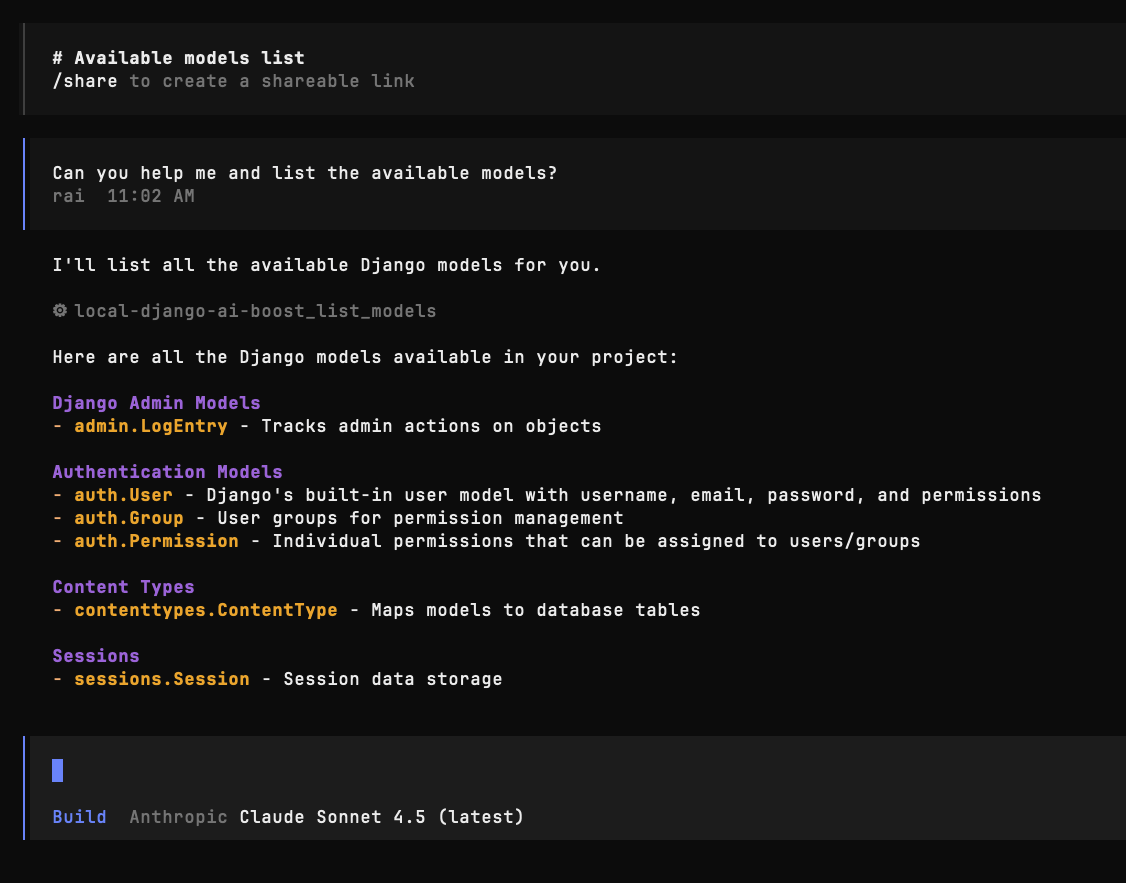
List every Django model with full field metadata, including types, max lengths, constraints, and relationships. AI agents can perform read-only ORM queries with filtering, ordering, and pagination (limited to 1000 rows) for safe exploration.
URL routing and resolution
Browse all URL patterns with names and view handlers. Reverse any named route and inspect namespaces like admin:index. When models implement get_absolute_url(), Django AI Boost returns their resolved URLs.
Application configuration insights
Explore Django settings using dot notation, check environment configuration, and see details such as Python and Django versions, installed apps, middleware, debug status, and database engine. This gives AI assistants a clear understanding of your app’s runtime environment.
Testing utilities
Surface information about available tests, test paths, and fixtures. Agents can reference testing contexts, suggest focused test execution, and use structured debugging outputs.
Documentation prompts and version awareness
Automatically generate targeted documentation prompts based on the Django version detected in your project. Agents receive links to correct documentation pages and guidance on best practices.
Project navigation and structure mapping
Surface the project tree, installed apps, and file paths. Provide quick insight into where models, views, templates, and static files live in your project.
Logging inspection
Expose recent application logs so AI agents can help identify errors, warnings, stack traces, and runtime anomalies. This mirrors the type of introspection Laravel Boost offers and enables assistants to give context-aware guidance on failures or unexpected behavior.
Error and debug diagnostics
Return structured information about exceptions, error messages, and debug traces captured during development. This lets an AI assistant reference real issues instead of guessing based on incomplete context.
Management command exploration
List all custom and built-in management commands available in your Django project, along with module paths and short descriptions.
Environment and dependency insights
Inspect installed Python packages, compare versions, and analyze mismatches or outdated dependencies when relevant.
The foundation: metaproductivity
Django AI Boost is built on the idea that productivity gains come from the environment around the model. Metaproductivity focuses on what enables an AI agent to produce high-quality work consistently: usable tools, accessible context, quick iteration loops, and lightweight feedback mechanisms.
These elements are familiar to any experienced developer. They are the same things that turn junior engineers into effective collaborators. With Django AI Boost, we shape an environment where AI can behave the same way.
MCP provides the structure to expose these capabilities in a predictable format. Django AI Boost builds on that infrastructure and adds the framework-specific tools that editors and AI assistants currently lack.
What comes next
Django Boost is already available on GitHub, and we plan to evolve it fully in the open. Real projects surface the most meaningful insights, so we want developers to explore the toolkit, try the existing MCP tools, and tell us what else would unlock real gains in their workflow.
You can follow the roadmap, open issues, propose tools, and contribute directly through the repository. This project works best when it grows with the community, and we are excited to shape it together.

